
Quick Summary
Clear roof snow from the ground with a telescoping roof rake, pulling it off in thin passes and leaving a couple of inches behind so the blade stays off your shingles. Raking earns its keep after storms that leave wet, packed snow, when ice starts building along the eaves, or when wind piles drifts into valleys and onto lower roofs. If you notice a sagging ceiling, fresh drywall cracks, or doors that suddenly stick, stop clearing, keep the family out of that room, and have a roofer look at the structure.Quick Summary
Homeowners in Montana typically pay between $5,000 and $50,000 for a full siding replacement on a standard home. Vinyl remains the most affordable option, while premium materials like fiber cement or cedar cost significantly more. Exact pricing depends on your home’s square footage and the current labor rates in Gallatin County.
Key Takeaways
Ground snow loads across mountainous Montana commonly fall within a general range of 40 to 60 pounds per square foot, and wet snow gets heavy far faster than powder.
A plastic-bladed roof rake, used with your boots on the ground, covers routine clearing on single-story homes and the lower edges of taller ones.
A thin layer of snow left on the roof protects shingles from scraping.
Flat roofs need open drains, and metal roofs can dump an entire panel of snow at once.
Rock salt, open flames, and icy ladders cause more damage and injuries than the snow itself.
Anyone who has spent a winter in the Gallatin Valley knows the pattern. A storm drops a foot of light powder on Tuesday, the sun comes out Thursday, and by the weekend that fluffy layer has settled into something closer to wet concrete. Around then, Bozeman homeowners start searching for how to remove snow from roof edges without dragging a ladder through the drifts.
Our crews work on Montana roofs all winter, and the winter injuries we hear about usually involve a ladder or a homeowner standing on an icy roof. So this guide starts from the ground and stays there as long as it can. You will find the tool we recommend, how to handle flat and metal roofs, and the point where it makes sense to hand the job to a professional crew.
How to Remove Snow From a Roof Safely From the Ground
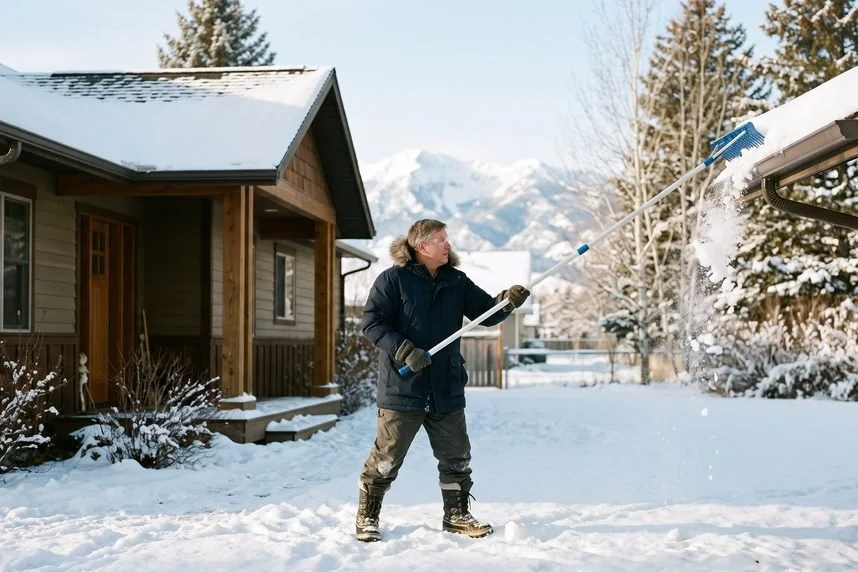
A roof rake looks like a wide, shallow shovel blade bolted to a long telescoping pole, and it lets you pull snow off the lower part of the roof with both feet planted in the yard. Pick one with a plastic or poly blade, or a model with small rollers that keep the edge lifted, because a bare aluminum lip can strip granules from asphalt shingles in a single season.
Before you pull anything down, walk the area under the eaves and move the car, the kids' sleds, and the dog. Then look up. Overhead power lines and the service drop running to your house are easy to forget once you are focused on the snow, and a metal or wet pole near them is dangerous. Start at the very edge of the roof and work in strips about as wide as the blade, reaching a little higher on each pass. Thin bites work better than big ones, because a heavy slab can slide straight back at you.
Stop when you are a couple of inches above the shingles. The last layer acts as a cushion between the rake and the roof, and it will melt off on its own. Concentrate on the first several feet above the gutters, which is where meltwater refreezes, and ice dams begin.
Boots with real tread and a pair of safety glasses are worth putting on, and so is a break every twenty minutes, because wet snow wears out shoulders quickly. If you are not sure your roof needs clearing at all, our guide to Gallatin County roof snow load requirements explains how local design loads are set.
Should You Remove Snow From Your Roof?
Homes across Gallatin County are designed to carry the weight of a mountain winter. In mountainous parts of Montana, the design starting point (the ground snow load) commonly falls in a general range of 40 to 60 psf, and the exact figure for your address depends on elevation and which jurisdiction you live in. A cabin up near Big Sky can carry a heavier design load than a house on the valley floor in Manhattan or Four Corners.
Depth alone can fool you. A foot of fresh powder is light enough to sweep off a deck with a broom. The same foot after a rain-on-snow day or a week of thawing and refreezing can weigh several times as much, and an ice layer hidden between two storms adds weight you cannot see from the driveway.
Raking becomes worth the effort when snow has packed down through several storms or when ice is forming along the eaves. Wind-driven drifts in a valley, behind a chimney, or on a low roof next to a taller wall are another good reason to clear. Older homes and roofs that showed strain in past winters deserve a closer eye as well.
How to Prevent Roof Collapse From Snow
A roof under too much weight usually complains before it fails, and collapses on well-kept homes are uncommon. Listen for creaking or popping from the attic during a heavy storm. Look for a dip along the ridgeline or across a bedroom ceiling, new hairline cracks where the drywall meets the ceiling, and interior doors that stuck yesterday but opened fine last week. Water stains after a thaw belong on that list too.
When any of those show up, get people out of the rooms underneath and stay off the roof. A roofer should look at the structure before anyone climbs up to shovel. Scheduling a roof inspection in Bozeman in the fall is the easier path. It can turn up soft decking, poor attic airflow, and framing concerns when the weather still allows repairs, and it is one of the simplest ways to prevent roof collapse from snow later in the season.
How to Remove Snow From a Flat Roof or a Metal Roof
Flat and Low-Slope Roofs
Snow on a flat garage or porch roof has nowhere to go, so it just sits and gets heavier. The drains and scuppers matter more here than the snow itself, and keeping them open gives meltwater a way off the roof before it freezes again overnight. You can rake the edges of a low porch from the ground. Larger flat roofs and commercial buildings are a different job that calls for a crew with fall protection and plastic shovels, because a steel edge can slice a membrane open in one stroke.
Metal Roofs
Metal sheds snow beautifully, and that is good news for the framing and bad news for anyone standing below. On a sunny February afternoon, an entire panel's worth can let go at once and bury a walkway. Keep doors, paths, and parking spots clear under metal eaves, and ask us about snow guards over entries and decks. If you do rake a metal roof, use plastic, because metal tools scratch the coating and give rust a place to start.
Removing Snow Without a Roof Rake and What to Avoid
You have probably seen the videos of someone sawing snow off a roof with a rope, or leaning out of an upstairs window with a push broom. Those tricks can work on a small roof, but they put you close to the edge or on a ladder, and they can drop a heavy slab on whoever happens to be underneath. A roof rake is an inexpensive tool, and buying one in November beats improvising in January.
A few shortcuts do more harm than good. Chipping at ice with a hammer or an axe cracks shingles and dents gutters. Rock salt eats at shingles, metal flashing, and the shrubs below the drip line. Heat guns, torches, and pressure washers have no place on a frozen roof, and neither does a metal blade scraped down to bare shingles. With a stubborn ice dam, a nylon stocking filled with calcium chloride and laid across the ice will melt a drainage channel slowly and safely. Solar panels need a soft-edged tool and the panel maker's own cleaning guidance.
Montana Winter Conditions That Change the Plan
Valley winters swing between bright afternoons and nights well below freezing. Snow melts on the warm upper part of the roof, runs down to the colder eaves, and freezes again, building the ice ridge that pushes water under shingles. Clearing the bottom few feet after each big storm keeps that cycle from getting a foothold.
Wind is the other local wrinkle. Gusts off the Bridgers and the Gallatin Range can scour one side of a roof and stack the snow on the other, packing drifts into valleys and against dormers. Homes at higher elevations, like those around Big Sky, often see deeper snowpacks and longer stretches below freezing, so they usually need clearing more often.
When to Call a Pro for Roof Snow Removal
A roof rake has a reach limit, and so does common sense. Two-story homes, steep pitches, thick ice along the eaves, and any roof showing signs of strain are safer in the hands of a crew with harnesses and the proper gear for working on snow. A professional on the roof can also spot loose flashing, cracked shingles, and ventilation problems during the same visit.
When people call us in the middle of winter, they want quick work and a straight answer. Debra, in a 5-star review, described our crew as "patching my roof in a very efficient manner." Seth gave us 5 stars as well and noted that Frank on our team "took the time to explain the entire roofing process." We bring that same approach to snow calls, starting with a free inspection and an honest opinion on whether the snow really needs to come off.
FAQs
-
No, pull it down gently with a rake instead of banging on the roof or gutters to break it loose. Frozen shingles crack easily, and hard knocks can also loosen gutter hangers.
-
It depends on the building, because a flat roof's limit is set by its design load and the weight of the snow. Ask a roofer or the local building office for your building's figure before a big storm hits.
-
We do not recommend spray lubricants on a roof. Petroleum products can harm shingles and coatings and wash into your gutters, so snow guards and regular raking are safer choices.
-
A layer of snow can add a small amount of insulation. Keep the bottom few feet clear even if you leave some snow higher up, because a little extra insulation is not worth a leaking ceiling.
-
We advise against it, because ladder feet slip easily on packed snow and ice. Use a telescoping rake from the ground, and call a professional crew for anything out of reach.
Staying Ahead of Heavy Montana Snow
Safe roof snow removal comes down to a good rake, thin passes, and paying attention to how your house behaves after each storm. Keep the eaves clear, give flat and metal roofs the extra care they need, and stop at the first sign of sagging, cracking, or leaks. A roof that goes into winter in good shape handles Montana snow far better than one hiding last year's damage.
If the snow on your roof looks heavier than your rake can handle, send our team a message, and Jolly Giant Roofing LLC will help you plan a safe next step.